Steely Dan Do It Again Organ
| Steely Dan | |
|---|---|
 Steely Dan performing in 2007. Walter Becker (50) playing electric guitar, Donald Fagen (r) playing melodica. | |
| Groundwork information | |
| Origin | Annandale-on-Hudson, New York, United States |
| Genres |
|
| Years active | 1971–1981, 1993–present |
| Labels |
|
| Associated acts |
|
| Website | steelydan |
| Members | Donald Fagen |
| Past members |
|
Steely Dan is an American stone band founded in 1971 in Los Angeles, California past cadre members Walter Becker (guitars, bass, backing vocals) and Donald Fagen (keyboards, lead vocals). Initially the band had a stable lineup, but in 1974, Becker and Fagen retired the band from alive performances altogether to become a studio-but band, opting to record with a revolving cast of session musicians. Rolling Rock has called them "the perfect musical antiheroes for the Seventies".[v]
The two had been playing together in a multifariousness of bands from their time together studying at Bard College in Annandale-on-Hudson, New York. The songwriting duo later on moved to Los Angeles, gathered a full band of musicians, and began recording albums. From their first album, Can't Buy a Thrill, they established a template for their career, blending elements of rock, jazz, Latin music, R&B, blues[6] and sophisticated studio production with ambiguous and ironic lyrics. The ring enjoyed disquisitional and commercial success through seven studio albums, peaking with their top selling anthology Aja, released in 1977.[6] After the grouping disbanded in 1981, Becker and Fagen worked sporadically on solo projects through the 1980s, though a cult post-obit[6] remained devoted to the grouping'south work. Since reuniting in 1993, Steely Dan has toured steadily and released two albums of new fabric, the first of which, Two Against Nature, earned a Grammy Award for Album of the Year. Their terminal album of new studio material was 2003's Everything Must Get, though the ring has continued to release compilations, box sets, and live albums on a regular basis. After Becker's passing in 2017, Fagen reluctantly connected the group with himself as the sole official fellow member.
They take sold more than 40 million albums worldwide and were inducted into the Stone and Roll Hall of Fame in March 2001.[7] [8] [9] [10] VH1 ranked Steely Dan at No. 82 on their list of the 100 Greatest Musical Artists of All Time.[xi] Rolling Stone ranked them No. 15 on its list of the xx Greatest Duos of All Fourth dimension.[12]
History [edit]
Formative and early years (1967–1972) [edit]
Becker and Fagen met in 1967 at Bard College, in Annandale-on-Hudson, New York. Equally Fagen passed by a café, The Reddish Balloon, he heard Becker practicing the electrical guitar."[thirteen] In an interview, Fagen recounted the feel: "I hear this guy practising, and information technology sounded very professional and gimmicky. It sounded like, you know, like a black person, actually."[13] He introduced himself to Becker and asked, "Practice you lot want to exist in a band?"[xiii] Discovering that they enjoyed similar music, the two began writing songs together.
Becker and Fagen began playing in local groups. One such group – known every bit the Don Fagen Jazz Trio, the Bad Rock Group and later the Leather Canary – included time to come comedy star Chevy Hunt on drums. They played covers of songs by The Rolling Stones ("Dandelion"), Moby Grape ("Hey Grandma"), and Willie Dixon ("Spoonful"), equally well as some original compositions.[13] Terence Boylan, some other Bard musician, remembered that Fagen took readily to the crackpot life while attending higher: "They never came out of their room, they stayed upwards all nighttime. They looked similar ghosts—black turtlenecks and skin and so white that it looked similar yogurt. Absolutely no activity, chain-smoking Lucky Strikes and dope."[13]
Later on Fagen graduated in 1969, the 2 moved to Brooklyn and tried to peddle their tunes in the Brill Edifice in midtown Manhattan. Kenny Vance (of Jay and the Americans), who had a production office in the building, took an interest in their music, which led to piece of work on the soundtrack of the low-budget moving picture (featuring Richard Pryor and Robert Downey Sr.) You've Got to Walk It Like You Talk It or You'll Lose That Beat out. Becker later on said bluntly, "Nosotros did it for the money."[14] A series of demos from 1968 to 1971 are available in multiple different releases, not authorized by Becker and Fagen.[15] This collection features approximately 25 tracks and is notable for its sparse arrangements (Fagen plays solo piano on many songs) and lo-fi product, a contrast with Steely Dan's after work. Although some of these songs ("Caves of Altamira", "Brooklyn", "Barrytown") were re-recorded for Steely Dan albums, most were never officially released.
Becker and Fagen joined the touring band of Jay and the Americans for well-nigh a year and a one-half.[xvi] They were at offset paid $100 per bear witness, but partway through their tenure the ring's bout manager cut their salaries in half.[sixteen] The grouping's lead singer, Jay Black, dubbed Becker and Fagen "the Manson and Starkweather of stone 'northward' whorl", referring to cult leader Charles Manson and spree killer Charles Starkweather.[16]
They had little success after moving to Brooklyn, although Barbra Streisand recorded their song "I Mean To Smoothen" on her 1971 Barbra Joan Streisand album. Their fortunes changed when one of Vance's assembly, Gary Katz, moved to Los Angeles to become a staff producer for ABC Records. He hired Becker and Fagen as staff songwriters; they flew to California. Katz would produce all their 1970s albums in collaboration with engineer Roger Nichols. Nichols would win six Grammy Awards for his piece of work with the band from the 1970s to 2001.[17]
Too realizing that their songs were too complex for other ABC artists, at Katz's suggestion Becker and Fagen formed their own ring with guitarists Denny Dias and Jeff "Skunk" Baxter, drummer Jim Hodder and vocalizer David Palmer, and Katz signed them to ABC as recording artists. Fans of Beat Generation literature, Fagen and Becker named the band after a "revolutionary" steam-powered dildo mentioned in the William South. Burroughs novel Naked Lunch.[xviii] [19] [twenty] Palmer joined every bit a second atomic number 82 singer because of Fagen'southward occasional stage fright, his reluctance to sing in front of an audience, and because the characterization believed that his voice was not "commercial" enough.
In 1972, ABC issued Steely Dan'due south first unmarried, "Dallas", backed with "Canvass the Waterway". Distribution of "stock" copies available to the full general public was manifestly extremely limited;[21] the single sold and then poorly that promotional copies are much more readily available than stock copies in today's collectors market. As of 2015, "Dallas" and "Sheet the Waterway" are the only officially released Steely Dan tracks that have not been reissued on cassette or compact disc. In an interview (1995), Becker and Fagen called the songs "stinko."[22] "Dallas" was later covered by Poco on their Caput Over Heels album.
Tin't Buy a Thrill and Countdown to Ecstasy (1972–1973) [edit]
Can't Buy a Thrill, Steely Dan'southward debut album, was released in 1972. Its hit singles "Practise It Again" and "Reelin' In the Years" reached No. 6 and No. eleven respectively on the Billboard singles nautical chart. Along with "Dirty Piece of work" (sung past David Palmer), the songs became staples on radio.
Because of Fagen's reluctance to sing live, Palmer handled well-nigh of the vocal duties on stage. During the kickoff tour, however, Katz and Becker decided that they preferred Fagen's interpretations of the ring's songs, persuading him to take over. Palmer quietly left the group while it recorded its second album; he later co-wrote the No. ii hit "Jazzman" (1974) with Carole King.
Released in 1973, Countdown to Ecstasy was not equally commercially successful as Steely Dan's first album. Becker and Fagen were unhappy with some of the performances on the tape and believed that information technology sold poorly because it had been recorded hastily on tour. The album'southward singles were "Show Biz Kids" and "My Old School", both of which stayed in the lower one-half of the Billboard charts (though "My Old School" and—to a lesser extent—"Bodhisattva" became FM Stone staples in time).
Pretzel Logic and Katy Lied (1974–1976) [edit]
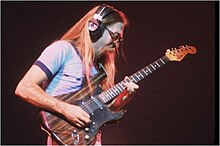
Guitarist Jeff "Skunk" Baxter left Steely Dan in 1974 when they ceased performing alive and began working in the studio exclusively.
Pretzel Logic was released in early on 1974. A diverse set, information technology includes the group's virtually successful single, "Rikki Don't Lose That Number" (No. 4 on the Billboard Hot 100), and a note-for-note rendition of Duke Ellington and James "Bubber" Miley'southward "East St. Louis Toodle-Oo".
During the previous album'southward tour, the band had added vocalizer-percussionist Royce Jones, vocaliser-keyboardist Michael McDonald, and session drummer Jeff Porcaro.[23] Porcaro played the sole drum track on one vocal, "Night By Night" on Pretzel Logic (Jim Gordon played drums on all the remaining tracks, and he and Porcaro both played on "Parker'south Ring"), reflecting Steely Dan's increasing reliance on session musicians (including Dean Parks and Rick Derringer). Jeff Porcaro and Katy Lied pianist David Paich would proceed to grade Toto. Striving for perfection, Becker and Fagen sometimes asked musicians to record as many every bit twoscore takes of each rails.[24]
Pretzel Logic was the first Steely Dan anthology to feature Walter Becker on guitar. "In one case I met [session musician] Chuck Rainey", he explained, "I felt there really was no demand for me to be bringing my bass guitar to the studio anymore".[24]
A rift began growing betwixt Becker-Fagen and Steely Dan's other members (peculiarly Baxter and Hodder), who wanted to tour. Becker and Fagen disliked constant touring and wanted to concentrate solely on writing and recording. The other members gradually left the band, discouraged past this and past their diminishing roles in the studio. Notwithstanding, Dias remained with the group until 1980's Gaucho and Michael McDonald contributed vocals until the group'due south twenty-year hiatus later on Gaucho. Baxter and McDonald went on to bring together The Doobie Brothers. Steely Dan's final tour performance was on July 5, 1974, a concert at the Santa Monica Borough Auditorium in California.[25]
Becker and Fagen recruited a diverse grouping of session players for Katy Lied (1975), including Porcaro, Paich, and McDonald, too as guitarist Elliott Randall, jazz saxophonist Phil Woods, saxophonist/bass-guitarist Wilton Felder, percussionist/vibraphonist/keyboardist Victor Feldman, keyboardist (and later producer) Michael Omartian, and guitarist Larry Carlton—Dias, Becker, and Fagen being Steely Dan'south only original members. The album went gold on the strength of "Black Friday" and "Bad Sneakers", merely Becker and Fagen were so dissatisfied with the anthology'southward sound (compromised past a faulty DBX dissonance reduction organization) that they publicly apologized for it (on the album's back cover) and for years refused to listen to it in its final course.[26] Katy Lied also included "Doctor Wu" and "Concatenation Lightning".
The Regal Scam and Aja (1976–1978) [edit]
The Royal Scam was released in May 1976. Partly because of Carlton'south prominent contributions, it is the band'south nigh guitar-oriented album. It also features performances by session drummer Bernard Purdie. The album sold well in the United States, though without the strength of a hit unmarried. In the U.k. the unmarried "Haitian Divorce" (Pinnacle twenty) drove album sales, becoming Steely Dan's offset major hit at that place.[27] Steely Dan's 6th album, the jazz-influenced Aja, was released in September 1977. Aja reached the Pinnacle V in the U.South. charts within three weeks, winning the Grammy accolade for "Engineer – Best Engineered Recording – Non-Classical." Information technology was also 1 of the first American LPs to exist certified 'platinum' for sales of over 1 million albums.[28] [29]
Roger [Nichols] made those records audio like they did. He was extraordinary in his willingness and desire to make records sound ameliorate.[xxx]
The records we did could not accept been done without Roger. He was just maniacal most making the sound of the records exist what we liked... He always thought there was a amend way to do information technology, and he would find a style to do what we needed to in ways that other people hadn't washed still.[31]
~ Steely Dan producer Gary Katz regarding Roger Nichols' role in the band's recording legacy.
Featuring Michael McDonald's backing vocals, "Peg" (No. eleven) was the album'due south first single, followed by "Josie" (No. 26) and "Deacon Blues" (No. 19). Aja solidified Becker's and Fagen's reputations as songwriters and studio perfectionists. Information technology features such jazz and fusion luminaries as guitarists Larry Carlton and Lee Ritenour; bassist Chuck Rainey; saxophonists Wayne Shorter, Pete Christlieb, and Tom Scott; drummers Steve Gadd, Rick Marotta and Bernard Purdie; pianist Joe Sample and ex-Miles Davis pianist/vibraphonist Victor Feldman and Grammy award-winning producer/arranger Michael Omartian (piano).
Planning to tour in back up of Aja, Steely Dan assembled a live ring. Rehearsal ended and the tour was canceled when bankroll musicians began comparing pay.[32] The album's history was documented in an episode of the TV and DVD series Classic Albums.
After Aja's success, Becker and Fagen were asked to write the title track for the movie FM. The movie was a box-office disaster, only the song was a striking, earning Steely Dan another engineering Grammy award. Information technology was a minor hit in the UK and barely missed the Summit 20 in the U.South.A.[27]
Gaucho and breakup (1978–1981) [edit]
Becker and Fagen took a break from songwriting for nigh of 1978 earlier starting piece of work on Gaucho. The project would not go smoothly: technical, legal, and personal setbacks delayed the anthology'south release and after led Becker and Fagen to append their partnership for over a decade.[33]
Misfortune struck early when an assistant engineer accidentally erased well-nigh of "The 2nd Arrangement", a favorite rail of Katz and Nichols,[34] which was never recovered. More than problem — this time legal — followed. In March 1979, MCA Records bought ABC, and for much of the adjacent two years Steely Dan could not release an album. Becker and Fagen had planned on leaving ABC for Warner Bros. Records, merely MCA claimed ownership of their music, preventing them from changing labels.
Turmoil in Becker's personal life also interfered. His girlfriend died of a drug overdose in their Upper West Side apartment, and he was sued for $17 million. Becker settled out of court, but he was shocked past the accusations and by the tabloid press coverage that followed. Presently subsequently, Becker was struck by a taxi while crossing a Manhattan street, shattering his right leg in several places and forcing him to use crutches.
Still more legal trouble was to come up. Jazz composer Keith Jarrett sued Steely Dan for copyright infringement, claiming that they had based Gaucho's title runway on one of his compositions, "Long As You Know You're Living Yours" (Fagen later on admitted that he'd loved the song and that it had been a stiff influence).[35]
Gaucho was finally released in Nov 1980. Despite its tortured history, it was another major success. The anthology'south first single, "Hey Nineteen", reached No. 10 on the pop chart in early on 1981, and "Time Out of Mind" (featuring guitarist Mark Knopfler of Dire Straits) was a moderate hitting in the jump. "My Rival" was featured in John Huston'due south 1980 movie Phobia. Roger Nichols won a third engineering Grammy award for his piece of work on the album.
Time off (1981–1993) [edit]
Steely Dan disbanded in June 1981.[36] Becker moved to Maui, where he became an "avocado rancher and self-styled critic of the contemporary scene."[37] He stopped using drugs, which he had used for nigh of his career.[38] [39] [40] Meanwhile, Fagen released a solo anthology, The Nightfly (1982), which went platinum in both the U.S. and the United kingdom of great britain and northern ireland and yielded the Summit Twenty hit "I.Chiliad.Y. (What a Beautiful World)." In 1988 Fagen wrote the score of Brilliant Lights, Big Metropolis and a song for its soundtrack, but otherwise recorded trivial. He occasionally did production work for other artists, equally did Becker. The most prominent of these were two albums Becker produced for the British sophisti-pop group China Crisis, who were strongly influenced by Steely Dan.[41] Becker is listed as an official member of Red china Crisis on the starting time of these albums, 1985's Flaunt the Imperfection, and played keyboards on the band's Top 20 Great britain hitting "Black Human Ray". For the second of the two albums, 1989'south Diary of a Hollow Horse, Becker is only listed as a producer and not every bit a band member.
In 1986 Becker and Fagen performed on Zazu, an anthology by erstwhile model Rosie Vela produced past Gary Katz.[42] The two rekindled their friendship and held songwriting sessions between 1986 and 1987, leaving the results unfinished.[43] On October 23, 1991, Becker attended a concert by New York Rock and Soul Revue, co-founded by Fagen and producer/vocaliser Libby Titus (who was for many years the partner of Levon Captain of The Band and would later become Fagen'south married woman), and spontaneously performed with the group.
Becker produced Fagen's 2nd solo album, Kamakiriad, in 1993. Fagen conceived the anthology as a sequel to The Nightfly.[ citation needed ]
Reunion, Live in America (1993–2000) [edit]

Steely Dan, shown here in 2007, toured ofttimes after reforming in 1993.
Becker and Fagen reunited for an American tour to support Kamakiriad, which sold poorly despite a Grammy nomination for Album of the Yr. With Becker playing lead and rhythm guitar, the pair assembled a band that included a second keyboard histrion, second lead guitarist, bassist, drummer, vibraphonist, three female backing singers, and four-piece saxophone section. Among the musicians from the live band, several would keep to piece of work with Steely Dan over the next decade, including bassist Tom Barney and saxophone players Cornelius Bumpus and Chris Potter. During this bout, Fagen introduced himself as "Rick Strauss" and Becker as "Frank Poulenc".
The next year, MCA released Denizen Steely Dan, a boxed set featuring their entire catalog (except their debut single "Dallas"/"Canvass The Waterway") on four CDs, plus four extra tracks: "Here at the Western World" (originally released on 1978's "Greatest Hits"), "FM" (1978 single), a 1971 demo of "Anybody's Gone to the Movies" and "Bodhisattva (live)", the latter recorded on a cassette in 1974 and released as a B-side in 1980. That yr Becker released his debut solo album, 11 Tracks of Whack, which Fagen co-produced.
Steely Dan toured again in support of the boxed ready and Tracks. In 1995 they released a live CD, Alive in America, compiled from recordings of several 1993 and 1994 concerts. The Art Crimes Tour followed, including dates in the United States, Japan, and their get-go European shows in 22 years. After this activity, Becker and Fagen returned to the studio to begin work on a new album.
Two Against Nature and Everything Must Go (2000–2003) [edit]
In 2000 Steely Dan released their kickoff studio album in 20 years: Ii Confronting Nature. It won four Grammy Awards: Best Engineered Album – Non-Classical, All-time Pop Vocal Anthology, All-time Pop Performance by Duo or Grouping with Vocal ("Cousin Dupree"), and Album of the Year (despite contest in this category from Eminem's The Marshall Mathers LP and Radiohead'due south Kid A). In the summer of 2000, they began another American tour, followed past an international bout later that year. The bout featured guitarist Jon Herington, who would go on to play with the ring over the next two decades. The group released the Plush TV Jazz-Rock Party DVD, documenting a live-in-the-studio concert performance of popular songs from throughout Steely Dan'south career. In March 2001, Steely Dan was inducted into the Rock and Roll Hall of Fame.[7] [8]
In 2002 during the recording of Everything Must Go, Becker and Fagen fired their engineer Roger Nichols, who had worked with them for 30 years, without explanation or notification, according to band biographer Brian Sweet'southward 2022 revision of his book Reelin' in the Years. [44]
In 2003 Steely Dan released Everything Must Become. In contrast to their earlier piece of work, they had tried to write music that captured a live experience. Becker sang pb vocals on a Steely Dan studio album for the first time ("Slang of Ages" — he had sung atomic number 82 on his ain "Book of Liars" on Alive in America). Fewer session musicians played on Everything Must Become than had get typical of Steely Dan albums: Becker played bass on every runway and lead guitar on five tracks; Fagen added pianoforte, electric pianoforte, organ, synthesizers, and percussion on top of his vocals; touring drummer Keith Carlock played on every track.
Touring, solo activity (2003–2017) [edit]
To consummate his Nightfly trilogy, Fagen issued Morph the Cat in 2006. Steely Dan returned to annual touring that year with the Steelyard "Sugartooth" McDan and The Fab-Originees.com Tour.[45] Despite much fluctuation in membership, the live band featured mainstays Herington, Carlock, bassist Freddie Washington, the horn section of Michael Leonhart, Jim Pugh, Roger Rosenberg, and Walt Weiskopf, and backing vocalists Carolyn Leonhart and Cindy Mizelle. The 2007 Heavy Rollers Bout included dates in Northward America, Europe, Nippon, Commonwealth of australia, and New Zealand, making it their nearly expansive tour.[46]
The smaller Recall Fast Tour followed in 2008, with keyboardist Jim Beard joining the live band. That year Becker released a 2d album, Circus Money, produced by Larry Klein and inspired by Jamaican music. In 2009 Steely Dan toured Europe and America extensively in their Left Bank Holiday and Rent Party Tour, alternate between standard ane-date concerts at big venues and multi-nighttime theater shows that featured performances of The Royal Scam, Aja, or Gaucho in their entirety on certain nights. The post-obit year, Fagen formed the touring supergroup Dukes of September Rhythm Revue with McDonald, Boz Scaggs, and members of Steely Dan'due south live band, whose repertoire included songs by all three songwriters. Longtime studio engineer Roger Nichols died of pancreatic cancer on April 10, 2011.[47] Steely Dan's Shuffle Diplomacy Bout that yr included an expanded ready listing and dates in Australia and New Zealand. Fagen released his fourth album, Sunken Condos, in 2012. Information technology was his commencement solo release unrelated to the Nightfly trilogy.
The Mood Swings: eight Miles to Pancake Twenty-four hours Bout began in July 2013 and featured an 8-night run at the Beacon Theatre in New York City.[48] Jamalot Ever After, their 2022 Us tour, ran from July 2 in Portland, Oregon to September 20 in Port Chester, New York.[49] 2015's Rockabye Gollie Angel Bout included opening act Elvis Costello and the Imposters and dates at the Coachella Valley Music and Arts Festival. The Dan Who Knew Too Much tour followed in 2016, with Steve Winwood opening. Steely Dan also performed at The Hollywood Bowl in Los Angeles with an accompanying orchestra.
The band played its last shows with Becker in 2017. In Apr, they played the 12-date Reelin' In the Chips residency in Las Vegas and Southern California.[50] Becker's final performance came on May 27 at the Greenwich Town Party in Greenwich, Connecticut.[51] Due to illness, Becker did not play Steely Dan'south two Classics E and W concerts at Dodger Stadium and Citi Field in July.[52] Fagen embarked on a bout that summer with a new bankroll ring, The Nightflyers.
Afterwards Becker'due south death (2017–nowadays) [edit]
Becker died from complications of esophageal cancer on September 3, 2017.[53] In a note released to the media, Fagen remembered his longtime friend and bandmate, and promised to "keep the music we created together alive as long as I can with the Steely Dan band."[54] Afterward Becker's expiry, Steely Dan honored commitments to perform a brusk North American tour in Oct 2022 and iii concert dates in the Uk and Ireland for Bluesfest on a double neb with the Doobie Brothers.[55] The band played its beginning concert following Becker'south death in Thackerville, Oklahoma, on October 13.[55] In tribute to Becker, they performed his solo song "Book of Liars", with Fagen singing the lead vocals, at several concerts on the tour.[56]
Becker's widow and estate sued Fagen afterwards that year, arguing that the manor should control 50% of the ring's shares.[57] Fagen filed a counter suit, arguing that the band had drawn upwardly plans in 1972 stating that band members leaving the band or dying relinquish shares of the ring'southward output to the surviving members. In December, Fagen said that he would rather have retired the Steely Dan name later on Becker's decease, and would instead have toured with the current iteration of the group under another name, but was persuaded non to by promoters for commercial reasons.[58]
In 2018, Steely Dan performed on a summertime tour of the The states with The Doobie Brothers as co-headliners.[59] The band also played a nine-show residency at the Beacon Theatre in New York City that October.[60] In February 2019, the band embarked on a tour of United kingdom of great britain and northern ireland with Steve Winwood.[61] Guitarist Connor Kennedy of The Nightflyers joined the live ring, offset with a nine-night residency at The Venetian Resort in Las Vegas in April 2019.[62]
Musical and lyrical style [edit]
Music [edit]
Overall sound [edit]
Special attention is given to the individual audio of each musical instrument. Recording is done with the utmost fidelity and attention to sonic detail, and mixed so that all the instruments are heard and none are given undue priority. Their albums are also notable for the characteristically 'warm' and 'dry out' production sound, and the sparing use of repeat and reverberation.
Backing vocals [edit]
Becker and Fagen favored a distinctly soul-influenced style of backing vocals, which later the first few albums were nigh always performed by a female chorus (although Michael McDonald features prominently on several tracks, including the 1975 song "Black Friday" and the 1977 vocal "Peg"). Venetta Fields, Sherlie Matthews and Clydie King were the preferred trio for backing vocals on the group's late 1970s albums.[63] Other bankroll vocalists include Timothy B. Schmit, Tawatha Agee, Carolyn Leonhart, Janice Pendarvis, and Catherine Russell.[ citation needed ] The band also featured singers like Patti Austin and Valerie Simpson on later projects such as Gaucho.[ citation needed ]
Horns [edit]
Horn arrangements have been used on songs from all Steely Dan albums. They typically feature instruments such as trumpets, trombones and saxophones, although they have besides used other instruments such equally flutes and clarinets. The horn parts occasionally integrate uncomplicated synth lines to change the tone quality of individual horn lines; for case in "Deacon Blues" this was done to "thicken" one of the saxophone lines. On their before albums Steely Dan featured guest arrangers and on their subsequently albums the organization piece of work is credited to Fagen.
Composition and chord employ [edit]
Steely Dan is famous for their use of chord sequences and harmonies that explore the surface area of musical tension between traditional popular sounds and jazz. In detail, they are known for their use of the add two chord, a type of added tone chord, which they nicknamed the "mu major". The mu major chord differs from a suspended second (sus2) chord, as suspended chords do not contain the major (or minor) 3rd.[64] [65] [66] In a 1989 interview, Walter Becker explained that the utilize of the chord adult from trying to enrich the sound of a major chord without making it into a "jazz chord".[67] In the Steely Dan Songbook, Becker and Donald Fagen state that "inversions of the mu major may be formed in the usual way with one caveat: the voicing of the second and third scale tones, which is the essence of the chord'southward appeal, should always occur every bit a whole tone dissonance."[68] Other common chords used by Steely Dan include slash chords.[ citation needed ]
Lyrics [edit]
Steely Dan's lyrical subjects are diverse, only in their bones approach they oftentimes create fictional personae that participate in a narrative or situation. The duo have said that in retrospect, most of their albums have a "feel" of either Los Angeles or New York Urban center, the 2 main cities where Becker and Fagen lived and worked. Characters appear in their songs that evoke these cities. Steely Dan's lyrics are often puzzling to the listener,[69] with the true meaning of the song "uncoded" through repeated listening, and a richer understanding of the references within the lyrics. In the vocal "Everyone's Gone to the Movies," the line "I know you lot're used to 16 or more than, sorry we just have eight" refers not to the count of some commodity, merely to 8 mm movie, which was lower quality than 16 mm or larger formats and ofttimes used for pornography, underscoring the illicitness of Mr. LaPage's movie parties.[lxx]
Thematically, Steely Dan creates a universe peopled past losers, creeps and failed dreamers, often victims of their own obsessions and delusions. These motifs are introduced in the Dan'south outset hit song, "Do It Once again," which contains a description of a murderous cowboy who beats the gallows, a human being taken advantage of by a cheating girlfriend, and an obsessive gambler, all of whom are unable to command their own destinies; similar themes of being trapped in a expiry spiral of one'southward ain making appear throughout their catalog. Other themes that they explore include prejudice, aging, poverty, and middle-grade ennui.
Many would argue that Steely Dan never wrote a genuine love song, instead dealing with personal passion in the guise of a subversive obsession.[71] Many of their songs concern beloved, merely typical of Steely Dan songs is an ironic or disturbing twist in the lyrics that reveals a darker reality. For example, expressed "love" is actually about prostitution ("Pearl of the Quarter"), incest ("Cousin Dupree"), pornography ("Everyone's Gone to the Movies"), or some other socially unacceptable subject.[72] However, some of their demo-era recordings show Fagen and Becker expressing romance, including "This Seat'southward Been Taken", "Oh, Wow, Information technology's Y'all" and "Come Back Baby".
Steely Dan'due south lyrics contain subtle and encoded references, unusual (and sometimes original) slang expressions, a wide diversity of "give-and-take games." The obscure and sometimes teasing lyrics have given rise to considerable efforts past fans to explain the "inner meaning" of certain songs.[73] [74] Jazz is a recurring theme, and there are numerous other film, boob tube and literary references and allusions, such every bit "Dwelling at Last" (from Aja), which was inspired past Homer'southward Odyssey.[75]
Some of their lyrics are notable for their unusual meter patterns; a prime example of this is their 1972 striking "Reelin' In the Years", which crams an unusually large number of words into each line, giving it a highly syncopated quality.
"Proper noun dropping" is some other Steely Dan lyrical device; references to existent places and people grow in their songs. The vocal "My Old School" is an case, referring to Annandale (Annandale-on-Hudson, New York, is home to Bard College, which both attended and where they met), and the Two Confronting Nature album (2000) contains numerous references to the duo's original region, the New York metro area, including the district of Gramercy Park, the Strand Bookstore, and the upscale nutrient store Dean & DeLuca. In the song "Glamour Profession" the decision of a drug deal is celebrated with dumplings at Mr. Chow, a Chinese restaurant in Beverly Hills. The band even employed self-reference; in the song "Show Biz Kids," the titular subjects are sardonically portrayed equally owning "the Steely Dan T-shirt."
The ring as well ofttimes proper noun-checks drinks, typically alcoholic, in their songs: rum and cokes ("Daddy Don't Live in That New York Urban center No More than"), piña coladas ("Bad Sneakers"), zombies ("Haitian Divorce"), black cows ("Black Cow"), Scotch whisky ("Deacon Blues"), retsina ("Domicile at Last"), grapefruit wine ("FM"), cherry wine ("Time Out of Mind"), Cuervo Gold ("Hey Xix"), kirschwasser ("Babylon Sisters"), Tanqueray ("Lunch with Gina"), Cuban cakewalk (Fagen's solo runway "The Adieu Look"), and margaritas ("Everything Must Become") are all mentioned in Steely Dan lyrics.[76]
Members [edit]
Current members
- Donald Fagen – atomic number 82 vocals, keyboards, saxophone (1972–1981, 1993–present)
Former members
- Walter Becker – guitar, bass, bankroll and lead vocals (1972–1981, 1993–2017; his death)
- Jeff "Skunk" Baxter – guitar, backing vocals (1972–1974)
- Denny Dias – guitar (1972–1974, studio contributions until 1977)
- Jim Hodder – drums, backing and pb vocals (1972–1974; died 1990)
- David Palmer – backing and lead vocals (1972–1973)
- Royce Jones – bankroll vocals, percussion (1973–1974)
- Michael McDonald – keyboards, backing vocals (1974, studio contributions until 1980)
- Jeff Porcaro – drums (1974, studio contributions until 1980; died 1992)
Timeline [edit]

Discography [edit]
Studio albums
- Tin't Buy a Thrill (1972)
- Countdown to Ecstasy (1973)
- Pretzel Logic (1974)
- Katy Lied (1975)
- The Royal Scam (1976)
- Aja (1977)
- Gaucho (1980)
- Ii Against Nature (2000)
- Everything Must Go (2003)
See also [edit]
- List of songwriter tandems
References [edit]
- ^ "STEELY DAN biography". Neat Rock Bible. Archived from the original on October 23, 2013. Retrieved August iii, 2013.
- ^ Gimmers, Mof. "Steely Dan'south Walter Becker Remembered". The Quietus . Retrieved Dec 2, 2017.
- ^ McCormick, Neil (September 3, 2017). "With Steely Dan, Walter Becker gave u.s.a. jazz-fusion perfection". The Telegraph. Archived from the original on Jan eleven, 2022. Retrieved May 8, 2021.
- ^ "The Steely Dan albums". September 13, 2007. Archived from the original on September 13, 2007.
- ^ "Steely Dan". Stone & Roll Hall of Fame. Retrieved Baronial 18, 2018.
- ^ a b c AllMusic Steely Dan: Biography.
- ^ a b "Rock and Scroll Hall of Fame Inductees". Archived from the original on Dec 4, 2006. Retrieved December 22, 2006.
- ^ a b "Countdown to Infamy". Archived from the original on September 21, 2013. Retrieved December 22, 2006.
- ^ "The Modesto Bee: Reelin' in the years with Steely Dan's Walker Becker". Modbee.com. August ane, 2008. Archived from the original on July 3, 2009. Retrieved October 15, 2011.
- ^ "Official Steely Dan | Tour Dates 2013 | MOOD SWINGS 'xiii | RESOURCES". Steelydan.com. Archived from the original on March ix, 2016. Retrieved Baronial 3, 2013.
- ^ "Ep. 215 – 100 Greatest Artists of All Fourth dimension (Hour ii) – The Greatest – Episode Summary, Highlights, and Recaps". VH1.com. Retrieved March x, 2015.
- ^ "twenty Greatest Duos of All Time". Rolling Stone. December 17, 2015. Retrieved September v, 2020.
- ^ a b c d e Brunner, Rob (March 17, 2006). "Back to Annadale: The Origins of Steely Dan". EW.com. Archived from the original on Jan 19, 2007. Retrieved June twenty, 2021.
- ^ Metal Leg Issue #2.
- ^ Becker, Walter (January 19, 2000). "For a Change". www.steelydan.com. Archived from the original on November 11, 2006. Retrieved Baronial 18, 2018.
- ^ a b c Metal Leg: Issue #one Archived August 28, 2008, at the Wayback Auto.
- ^ "Roger Nichols". Archived from the original on November thirty, 2010. Retrieved September three, 2010.
- ^ "The Return of Steely Dan". Mojo Magazine. October 1995. Retrieved December 15, 2006.
- ^ "Official Steely Dan FAQ". Archived from the original on December 27, 2011. Retrieved January eighteen, 2007.
- ^ Burroughs, Williams S. (1962). Naked Lunch (1991 reprint ed.). New York: Grove Press. p. 77.
- ^ "45cat – Steely Dan – Dallas / Canvas The Waterway – ABC – Us – ABC-11323". Retrieved March x, 2015.
- ^ "Steely Dan interview with CompuServe members". Granatino.com. Oct 20, 1995. Archived from the original on September 27, 2011. Retrieved October 15, 2011.
- ^ "Timeline Bio | Official Steely Dan". Steelydan.com. October 11, 2006. Archived from the original on March 16, 2012. Retrieved October 15, 2011.
- ^ a b Q Magazine, No 103 April 1995. "Hasn't he grown", written by Andy Gill, pages 41–three published by EMAP Metro
- ^ "Steely Dan official FAQ: The Afterwards Steely Dan Years". Archived from the original on December 27, 2011. Retrieved March 22, 2012.
- ^ Dias, Denny. "Katy and The Gremlin". www.steelydan.com. Archived from the original on November 30, 2017. Retrieved August eighteen, 2018.
- ^ a b "UK Official Charts Company". www.officialcharts.com . Retrieved August eighteen, 2018.
- ^ "The Rolling Stone 500 Greatest Albums of All Time". Rolling Stone . Retrieved December 21, 2006.
145. Aja, Steely Dan
- ^ "Grammy Honor Winners". Retrieved December 21, 2006.
- ^ Sisario, Ben (April 17, 2011). "Roger Nichols, 66, Artist Amongst Sound Engineers". The New York Times . Retrieved Apr 18, 2011.
- ^ Cromelin, Richard (Apr 13, 2011). "Roger Nichols dies at 66; engineer gave Steely Dan its distinctive audio". Los Angeles Times . Retrieved April 18, 2011.
- ^ Steely Dan - Robert Klein Interview 12/fifteen/1980 - Part 2 on YouTube
- ^ James L. Kelley, "Steely Dan's Donald Fagen: A example of mistaken self-identity, corrected by self-reformulation." In: E. Vanderheiden, & C.-H. Mayer (Eds.), Mistakes, errors and failures beyond cultures: Navigating potentials (pp. 91-107). Cham, Switzerland: Springer, 2019, p. 100.
- ^ Sweetness, Brian (2000). Steely Dan: Reelin' in the Years. Bus Printing. p. 137. ISBN9780711982796.
- ^ Breskin, David (c. 1980). "Steely Dan (Interview)". Musician Mag. Archived from the original on March 10, 2007. Retrieved December 21, 2006.
- ^ Anderson, Stacey (June 21, 2011). "When Jimmy Page Debuted With the Yardbirds and Steely Dan Broke Up". Rolling Stone . Retrieved October 25, 2011.
- ^ Fagen, Donald. "Timeline Bio | Official Steely Dan". www.steelydan.com. Archived from the original on March 16, 2012. Retrieved August 18, 2018.
- ^ "Salon.com: Sophisticated skank". Archived from the original on May 21, 2008. Retrieved June 19, 2008.
- ^ "LA Times Interview with Steely Dan: Return of the Nightfly". Archived from the original on March 20, 2008. Retrieved June xix, 2008.
- ^ "Stylus Mag review: Steely Dan – Gaucho – On Second Thought". Archived from the original on August seven, 2020. Retrieved June nineteen, 2008.
- ^ Bush, John. "China Crisis | Biography". AllMusic . Retrieved January 26, 2014.
- ^ "Rosie Vela: Facing The Music". Metal Leg – The Steely Dan Magazine. May 1994. Archived from the original on February 17, 2012. Retrieved March 22, 2012.
- ^ Sakamoto, John (February 29, 2000). "The Steely Dan Q & A". Jam!. Archived from the original on May 12, 2013. Retrieved May 27, 2012.
- ^ Sweetness, Brian (August 16, 2018). Steely Dan: Reelin' in the Years. Omnibus Press. ISBN9781787591295 – via Google Books.
- ^ "Steely Dan Announce Summertime U.S. Tour with Michael McDonald". Archived from the original on December 5, 2006. Retrieved December 22, 2006.
- ^ "Official Steely Dan | Heavy Rollers Tour 2007". Steelydan.com. Archived from the original on October 11, 2011. Retrieved October fifteen, 2011.
- ^ Morris, Christopher (April 10, 2011). "Roger Nichols, music engineer, dies". Variety . Retrieved Apr ten, 2011. [ permanent dead link ]
- ^ "Official Steely Dan | Tour Dates 2013 | Mood Swings '13". Steelydan.com. July 29, 2013. Archived from the original on August five, 2013. Retrieved August iii, 2013.
- ^ "Steely Dan announces North American tour". USA Today. April fourteen, 2014. Retrieved April 19, 2015.
- ^ "Steely Dan Stays Consistent, Complex, Absurd in Las Vegas Residency". Las Vegas Review-Journal. Apr 25, 2017. Retrieved September 3, 2017.
- ^ "Watch Steely Dan's Final Concert With Walter Becker". Rolling Stone. September five, 2017. Retrieved September 14, 2017.
- ^ "Steely Dan at Archetype Due east - Minus Walter Becker". Best Classic Bands. July 30, 2017. Retrieved September 3, 2017.
- ^ Kreps, Daniel (September 3, 2017). "Walter Becker, Steely Dan Co-Founder, Dead at 67". Rolling Stone . Retrieved September 3, 2017.
- ^ Saperstein, Pat (September 3, 2017). "Steely Dan's Donald Fagen on Walter Becker: 'Hysterically Funny, a Peachy Songwriter'". Multifariousness . Retrieved September 3, 2017.
- ^ a b Kreps, Daniel (September 11, 2017). "Steely Dan Denote Tour Following Walter Becker'south Death". Rolling Stone . Retrieved September 12, 2017.
- ^ "Watch Steely Dan Pay Tribute to Walter Becker With a Rare Performance of "Book of Liars"". Spin. October 19, 2017. Retrieved Oct xix, 2017.
- ^ Hughes, William (November 22, 2017). "Steely Dan Now Reelin' in the Lawsuits". The A.V. Order.
- ^ "Donald Fagen Discusses the Loss of Walter Becker and Steely Dan'due south Future". Rolling Stone. December nineteen, 2017. Retrieved December xx, 2017.
- ^ "Steely Dan & The Doobie Brothers Announce 2022 Summertime Tour". JamBase. January viii, 2018.
- ^ Giles, Jeff. "Steely Dan Announce Themed Performances for 2018". Ultimate Classic Rock . Retrieved January 31, 2019.
- ^ "Steely Dan announces 2022 U.Yard./Ireland bout with Steve Winwood". AXS . Retrieved Jan 31, 2019.
- ^ Barry, John West. (February 13, 2019). "Steely Dan: Woodstock guitarist Connor Kennedy joins iconic band". Poughkeepsie Journal . Retrieved February 14, 2019.
- ^ Steely Dan Session Players Archived February 16, 2005, at the Wayback Motorcar, Under the Banyan Trees with Steely Dan (athenaeum). Retrieved January eighteen, 2007
- ^ "Intro to the Steely Dan Song Book". Archived from the original on January 3, 2010. Retrieved February ten, 2010.
- ^ "Explanation of the Steely Dan Mu Major Chord". Retrieved February 10, 2010.
- ^ "Steely Dan Chords". Retrieved January 20, 2010.
- ^ "Wintertime 1989 interview with Walter Becker" Archived 2005-02-10 at the Wayback Auto, Metal Leg: The Steely Dan Magazine, Issue 14, Fall 1990.
- ^ Becker and Fagen. "Intro to the Steely Dan Song Book ", SteelyDan.com. Posted 05/96.
- ^ Reed, Bobby (Oct 8, 2003). "Steely Dan goes back in time to 1979". Chicago Sun-Times . Retrieved August iv, 2016.
- ^ Stonemason, Stewart. "Steely Dan - Everyone's Gone to the Movies - Overview". Allmusic.com . Retrieved August v, 2021.
{{cite spider web}}: CS1 maint: url-status (link) - ^ Rolls, Chris (March 2, 2006). "Interview with Donald Fagen". MP3.com. Archived from the original on March 10, 2007. Retrieved December 21, 2006.
- ^ "Uncovering the mysteries of Steely Dan". Pittsburgh Post-Gazette . Retrieved November 5, 2017.
- ^ "The Steely Dan Dictionary". Retrieved December 21, 2006.
- ^ "Welcome folio". Retrieved March 10, 2015.
- ^ Alan Lewens (Director) (2000). Classic Albums: Steely Dan: Aja (television episode).
- ^ Breithaupt, Don (May 17, 2007). Steely Dan's Aja. 33 one/iii. Vol. 46 (1st ed.). New York: Continuum Books. p. 130pp. ISBN978-0-8264-2783-0. OL 17441224M. Retrieved Oct 29, 2011.
External links [edit]
- Official website

Source: https://en.wikipedia.org/wiki/Steely_Dan
0 Response to "Steely Dan Do It Again Organ"
Post a Comment